Chance of a mutual yes
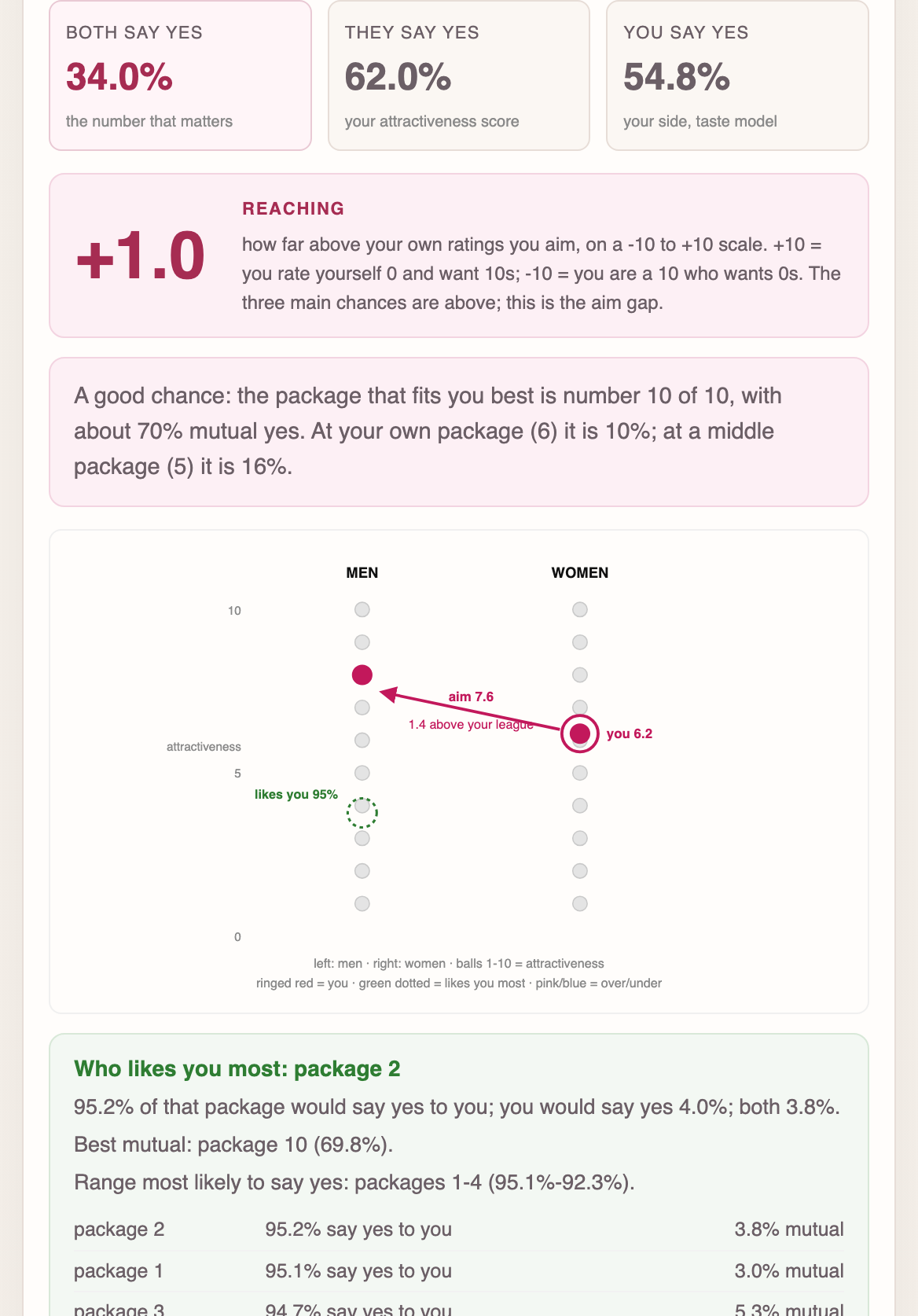
Your yes and their yes are predicted separately, then multiplied. The market side is the weaker model, and the UI prints both directions instead of hiding it.
v1.6.1 · local-first · no account
A small neural network trained on 8,378 real speed dates. It estimates your chance of a mutual yes, maps the packages you can reach, and puts the measured couple market next to it. Every number is trained, measured, or explicitly labelled a research prior.
Cross-validated on dates the model never saw. An always-guess baseline is printed next to every accuracy — no number stands alone.
The hypergamy map
P(he says yes) × P(she says yes)
Best cells — the ink ring is the highest mutual chance in each man's row; the blue ring is the highest in each woman's column. They are grid maxima, not your result.
What it estimates
The calculator answers the questions the data can actually support, and keeps the weak answers visibly weak instead of turning them into a single confident score.
Your yes and their yes are predicted separately, then multiplied. The market side is the weaker model, and the UI prints both directions instead of hiding it.
Your own arrow on the map plus a reaching score from −10 to +10: the gap between what you offer and what you look for.
Where your age, income, goal and self-ratings sit in the study pool, compared against the date data rather than an opinion about your worth.
Likely at 60% or more of your best cell, stretch at 25–60%, hard below 25%. A model output, not a promise about any real person.
About twenty inputs, with optional fields you can leave blank. Nothing is required beyond age and income.
Age, mode and gender decide which committed model runs — including the 18–25 average.
The map, partner panel and calibration block each carry a trained, measured or research label.
Rows are men, columns are women, and every one of the 100 cells is a real forward pass:P(he says yes) × P(she says yes). The diagonal structure comes from the ten rungs — looks, age and income climb together — not from a decorative gradient.
| package | looks | age | income |
|---|---|---|---|
| 1 | 3.0 / 10 | 24 | $21.0k |
| 2 | 3.8 / 10 | 25.1 | $25.5k |
| 3 | 4.6 / 10 | 26.2 | $30.0k |
| 4 | 5.3 / 10 | 27.3 | $34.5k |
| 5 | 6.1 / 10 | 28.4 | $39.0k |
| 6 | 6.9 / 10 | 29.5 | $43.5k |
| 7 | 7.7 / 10 | 30.6 | $48.0k |
| 8 | 8.4 / 10 | 31.7 | $52.5k |
| 9 | 9.2 / 10 | 32.8 | $57.0k |
| 10 | 10.0 / 10 | 33.9 | $61.5k |
Package 10 is a 34-year-old on about $61.5k, rated 10/10 on looks — the top rung the model builds, not “the perfect woman”, and not a score out of ten.
A single percentage hides which model produced it. Here the trained decision, the measured couple market and the research priors stay separate — because they answer different questions and have very different error bars.
The paper trail
There are only three kinds of numbers in this project. If a claim does not fit one of them, it does not ship.
trained
81.1% ± 2.1 five-fold CV for the men's taste model, against a 50.1% always-guess baseline. Committed weights run without retraining and reproduce the published CVs.
measured
250,172 ACS couples and 6,262 NHANES heights. Descriptive context only — the couple data is never fed to the date-acceptance network.
research
Adult-layer effects come from named papers in adult.py and are capped at ±8 points, so they cannot outvote the networks. Never described as trained.
| model | inputs | 5-fold CV | always-guess | lift |
|---|---|---|---|---|
| taste, men | 16 | 81.1% ± 2.1 | 50.1% | +31.0 |
| taste, women | 16 | 80.3% ± 1.8 | 65.8% | +14.5 |
| market, men | 8 | 66.1% ± 2.5 | 61.5% | +4.6 |
| market, women | 8 | 63.9% ± 2.0 | 55.8% | +8.1 |
| dyad, men | 20 | 80.9% ± 1.1 | 50.1% | +30.8 |
| map / base | 10 | 77.4% ± 1.2 | 57.0% | +20.4 |
Five-fold cross-validation on dates the model never saw. Holdout accuracy, feature sets and the full per-model table live in the README. The market model is weaker because a stranger's yes is mostly noise — +5 to +8 points, not +30.
The measured part
Not a forecast — the realised-couple distribution for people with your age and income, from the 2023 American Community Survey. These are couples who actually formed.
The panel shows the median partner age, income, age gap, same-ethnicity and same-education shares for your ACS cell, plus a deterministic 25th/50th/75th percentile grid. Same-education sits at 53.8% in that cell and same ethnicity at 73.2%; overall same-education is 47.5%.
The candidates carry no dyad score. The ACS records no partner self-ratings or stated importance, and imputing them produced 52% mutual chances against a 16.5% base rate — an artefact, so the scoring was removed.
No data shipped here follows a person to a lifetime partner, so “lifetime” is not claimed. HCMST is the right panel for that question; it is cited, not trained.
Run it
The calculator is a stdlib Python desktop app. No browser, no account, no API key, no upload. The first data build downloads the public speed-dating files and joins them locally.
# clone and install
git clone https://github.com/thijnperd/h-AI-pergamy.git
cd h-AI-pergamy
python -m pip install -r requirements.txt

# build the joined dataset, then open the desktop calculator
python data/build.py
python gui.py

# legacy browser UI only; the default above needs no browser
python gui.py --serve

# optional: regenerate the map as svg + png
python hypergamy_map.pyThe desktop app does all maths on your machine and there is no analytics script. Your profile never leaves the machine.
python profile.py --demopython partner.py --demopython adult.pypython -m unittest discover -s tests -vPython with pip, NumPy and Tk. Tk ships with most Windows/macOS Python installs; on Debian/Ubuntu add python3-tk. No web framework, no database, no build step.
Data
| source | size | used for |
|---|---|---|
| Speed Dating Experiment, Columbia 2002–04 | 8,378 dates | Trained targets: dec, dec_o, match |
| ACS 2023 1-year PUMS (CA, TX, FL, NY, IL) | 250,172 couples | Measured partner age, income, gap, same ethnicity/education |
| NHANES Aug 2021–Aug 2023 | 6,262 adults | Measured height percentiles |
| OKCupid profiles (JSE) | 59,946 | Descriptive height/body priors — no date-outcome label, so never trained |
| HCMST | cited | The right panel for lifetime stability; not shipped, not trained |
Raw downloads are gitignored. The small priors JSON files are committed so the calculator runs after a clone; the builders reproduce them from the public sources.
The public OKCupid file has 59,946 profiles but no column for a date decision or a mutual match. A supervised acceptance model needs that label; fitting one anyway would mean inventing the target. It is used only for descriptive height and body priors, never as a yes/no example.
HCMST has real relationship outcomes, not date decisions, and is cited rather than shipped. The public “online dating matches” Kaggle dataset was checked and excluded because it is synthetic. No additional real, redistributable profile-to-match dataset was found for this release, so the acceptance networks remain trained only on the 8,378 real speed dates.
Limits
No. It is a statistical toy with a published paper trail: a local calculator, not advice about a specific person and not a matchmaking service.
No. The speed-dating study ends at “second date?”, and no dataset shipped here follows a person to a partner. The partner panel reports ACS realised couples for your age and income; HCMST is the correct panel for longitudinal stability, and it is cited rather than simulated.
Because a stranger's decision is mostly noise. The market models clear their baselines by +4.6 to +8.1 points, while the taste models — whether you say yes — clear theirs by +14.5 to +31.0. The UI shows both rather than pretending they are equally reliable.
The public file has 59,946 profiles but no date-decision or mutual-match label. Training it as a yes/no model would mean inventing the outcome. It supplies descriptive height and body priors only; the acceptance networks use the 8,378 real dates.
The trained date models run, but the measured couple context returns “not available”: the ACS priors shipped here are opposite-sex couples only. The app says that instead of silently substituting a different population.
They are labelled research priors, cited to published studies and capped at ±8 points. There is no public outcome data for kinks or body measurements, so those effects never pretend to be trained.
No. The GUI is served by Python's standard library on 127.0.0.1, with no telemetry and no external calls at compute time. The only network access is the one-time public dataset download in data/build.py.