Search is not screening
Academic search is good at finding papers that share vocabulary with a query and bad at knowing what the query meant. A search for strength training in older adults returns work on strength in children, work where strength is an outcome rather than an intervention, and reviews that cite the papers you actually wanted.
PapersPlease adds the step that usually happens by hand: read the title and abstract, decide whether the paper is in scope, adjacent or irrelevant, and only then follow the link.
One pipeline, four surfaces
The same core sits behind four ways to use it:
- A CLI for a single query, with flags for count and interactivity.
- A TUI for moving through results and abstracts without leaving the terminal.
- A Python library for putting the pipeline inside another script.
- An MCP server so a coding agent can search literature as a tool call.
Four surfaces is a constraint on the design: the screening logic cannot live in the CLI's output formatting or the TUI's widgets, so it sits in one place and every surface renders the same verdicts.
Reading before downloading
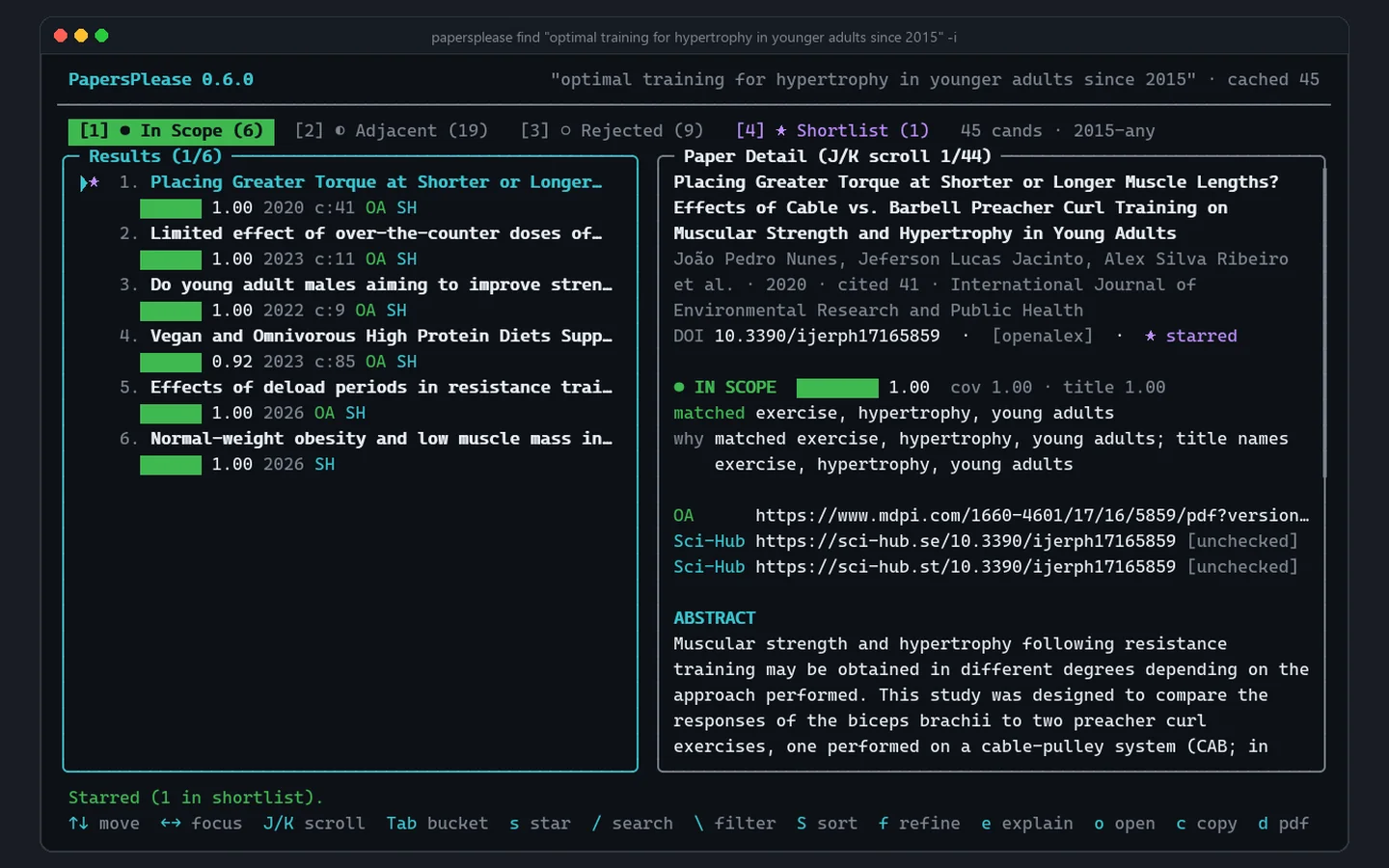
PapersPlease queries Europe PMC, Crossref, arXiv, Semantic Scholar and OpenAlex, then screens each candidate's title and abstract for scope: does it study the population, intervention and outcome the query asked about, and does the causal direction match? Results are grouped as in-scope, adjacent or rejected, with a relevance score.
For the papers that survive, it resolves open-access links and verifies that a download is actually a PDF rather than a landing page. A link that 404s is worse than no link, because it costs the same attention and returns nothing.
papersplease find "muscle strength in older adults since 2015" -iZero dependencies
The core runs on the Python standard library: HTTP, JSON, the CLI and the terminal interface. The only optional extra is PDF text extraction. That makes it installable anywhere Python exists, with no lockfile to rot and no transitive surprises. The trade-off is real — HTTP retries, terminal layout and argument parsing are written rather than imported — but it keeps the tool small enough to read in an afternoon.
What it cannot do
This is a screening aid, not a systematic review. Abstracts omit methods, overstate findings and sometimes lie; the heuristics will put a relevant paper in the rejected group. Coverage is limited to the five sources it queries, and the final judgement is still reading the paper. The tool's job is to make that pile smaller and better labelled, not to replace it.
Try it
The repository has the install line, the CLI and TUI usage, and the MCP configuration.