Notes outgrow folders
A vault of a few hundred Markdown files has structure, but not the structure the folder tree suggests. Notes written months apart connect; folders are just where they happened to be filed. Most tools answer this with search, or with a graph that is either a decorative hairball or a feature of a paid cloud service.
Cortex takes the third option: read the folder as it is, parse the links, and give the same data several shapes. Nothing is imported and nothing is copied. If you delete the app, the notes are still exactly where they were.
Read in place, build once
Cortex points at a vault and parses it directly: Markdown files, frontmatter, wikilinks. That becomes one in-memory model for the session. There is no database to migrate and no index to rebuild — the folder is the source of truth.
Layout is deterministic. The same vault produces the same map, which matters more than it sounds: a map that reshuffles every launch is a screensaver, not a way to remember where something lives. The stress-test vault is 5,523 notes across 41 folders, with 24,151 links.
Six views, one model
Graph, brain, timeline, atlas, bento and decisions are projections of the same parsed vault, not six separate tools:
- Graph — what links to what, without the folder tree in the way.
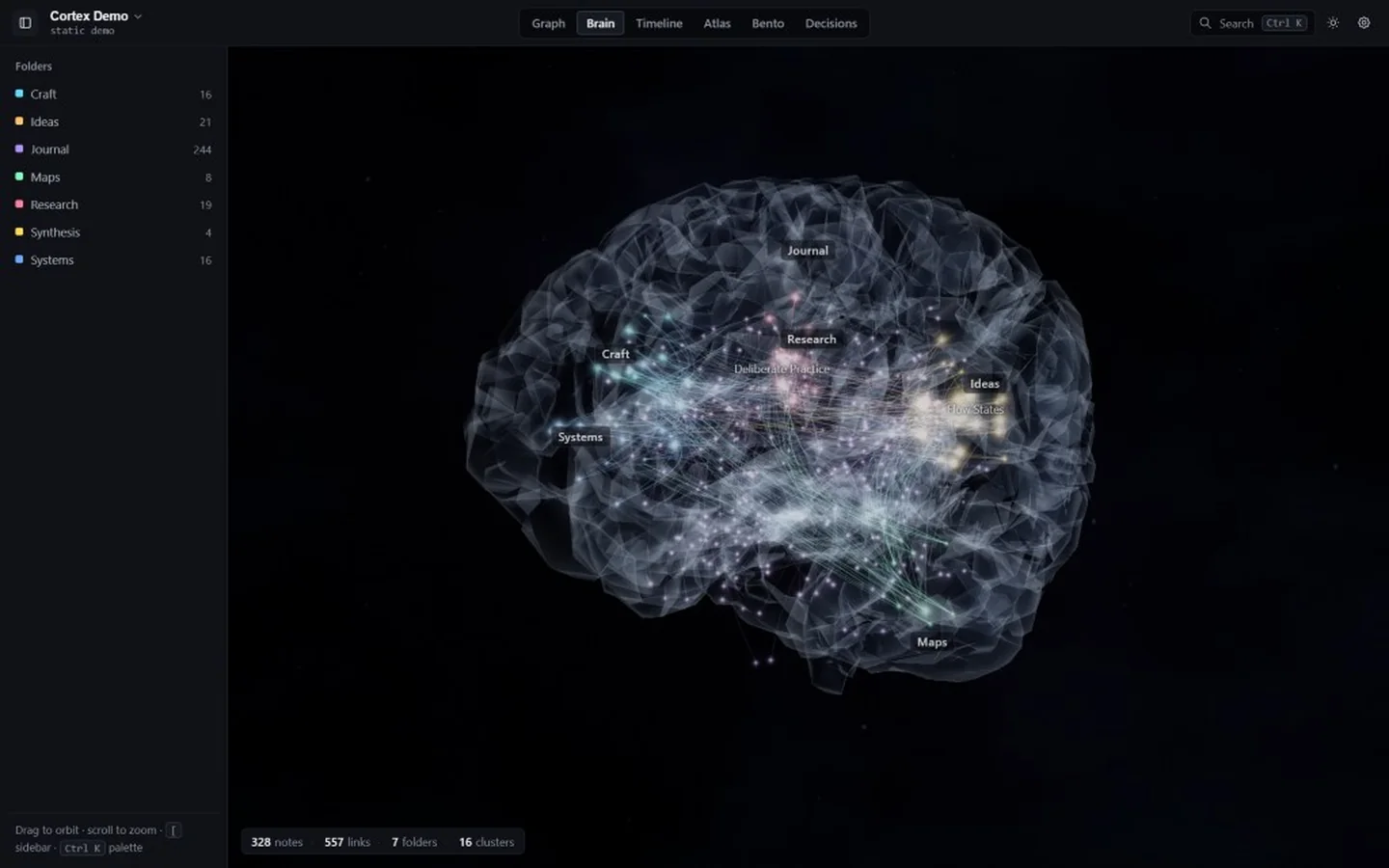
- Brain — the vault as a folded surface, folders as regions.
- Timeline — when the notes were written, and what clusters in time.
- Atlas — folders as countries, notes as places, links as roads, on a map that grows the same way every time.
- Bento — every folder as a box, sized by how much of the vault it holds, with its strongest notes inside.
- Decisions — the reasoning trail behind a choice, kept next to the choice.
The decisions view is the one that changes how the vault gets used. A note that records a decision is only useful if the alternatives and the reason survive with it, and that is a data-shape problem before it is a visual one.
Rust, WebGL2, and a local server
The Rust core does the expensive part: scanning, parsing, link resolution and layout. An axum server exposes that to a hand-written WebGL2 interface, which is what makes thousands of nodes interactive rather than a static image. The app is a local server opened in your browser, bound to loopback by default, and the Windows build wraps it in an installer.
cargo run -p cortex -- serve ./vaultThe GitHub Pages build is a static export of a seeded vault, so the views can be tried without installing anything.
What local-only costs
The installer is Windows-only, there is no mobile app, and there is no sync between machines: iCloud, Dropbox, Syncthing or git have to do that job. Those are real limits. They are also the reason the app opens in a second and never asks for an account, and the reason a vault can be moved, backed up or versioned like any other folder.
Try it
Open the live demo to move through the six views with the sample vault, or read the source.